

Enterprises rarely fail because they lack process. They fail because the real process—the one that actually keeps work moving—lives in people.
It’s the senior ops lead who knows which “urgent” requests are truly urgent. The finance manager who can spot a risky vendor contract in two minutes. The support rep who knows which customer complaint is a precursor to churn. The engineering lead who can predict where a release will break because they’ve seen the pattern before.
That accumulated context is tribal knowledge: instincts, shortcuts, unwritten rules, and situational awareness built over years. It’s valuable precisely because it’s nuanced. But it’s also fragile—because it’s invisible.
When critical decisions depend on what someone “just knows,” scalability, continuity, and resilience are compromised. Teams become dependent on specific individuals. Onboarding slows down. Quality becomes inconsistent. And when key people leave, the organization doesn’t just lose capacity—it loses memory.
The opportunity isn’t to eliminate tribal knowledge. It’s to compute it.
The real problem: invisibility, not absence
Most organizations already have SOPs, checklists, and documentation portals. Yet the highest-impact decisions still happen in Slack threads, hallway conversations, and escalation calls.
That’s because documentation captures what should happen, while tribal knowledge captures what actually happens:
- The exceptions that occur in the real world
- The trade-offs people make under pressure
- The signals that experienced operators use to decide quickly
- The edge cases that never made it into a process diagram
If you can’t observe it, you can’t measure it. If you can’t measure it, you can’t improve it. And if you can’t encode it, you can’t scale it.
Custom software as an enterprise memory layer
At Deventure.co, we see custom software not just as automation—but as a way to turn tacit, experience-driven knowledge into structured, executable workflows.
The shift is subtle but powerful:
- From “Ask Maria how we handle this”
- To “The system knows how we handle this—and why”
This is where enterprise memory becomes encoded—not in static SOPs, but in adaptive systems.
Step 1: Instrument reality with event-driven workflows
The foundation is visibility. Before you can compute tribal knowledge, you need to capture the signals that represent real work.
A practical approach begins with event-driven architecture:
- User actions, approvals, and exceptions are logged as state transitions
- Each transition is tied to context (role, department, customer segment, priority, risk level)
- Every decision point becomes a traceable event, not an anecdote
Over time, those transitions form a behavioural dataset that reflects how work actually gets done—not how it was originally designed.
This matters because tribal knowledge often lives in the “in-between” moments: when someone overrides a default, escalates a case, or chooses a non-obvious path. Those moments are the raw material of operational intelligence.
Step 2: Make tacit knowledge actionable with rule engines
Once reality is observable, the next step is turning patterns into execution.
Tacit knowledge becomes actionable when it’s embedded into rule engines that evolve based on usage patterns. Instead of hardcoding brittle logic, you design systems where rules can be:
- Explicit (if X, then Y)
- Contextual (if X and customer tier is enterprise, then Y)
- Governed (approved changes, versioning, audit trails)
- Iterative (refined as new edge cases emerge)
Decision trees can be dynamically updated using feedback loops. Workflow orchestration layers can capture edge-case handling that typically lives in conversations or escalations.
The result: the organization’s best instincts become reusable.
Step 3: APIs to break the “informal coordination” bottleneck
A lot of tribal knowledge exists because systems don’t talk. When departments can’t access shared context, they compensate with informal coordination:
- “Can you check with ops?”
- “Let me ask finance.”
- “I’ll ping legal.”
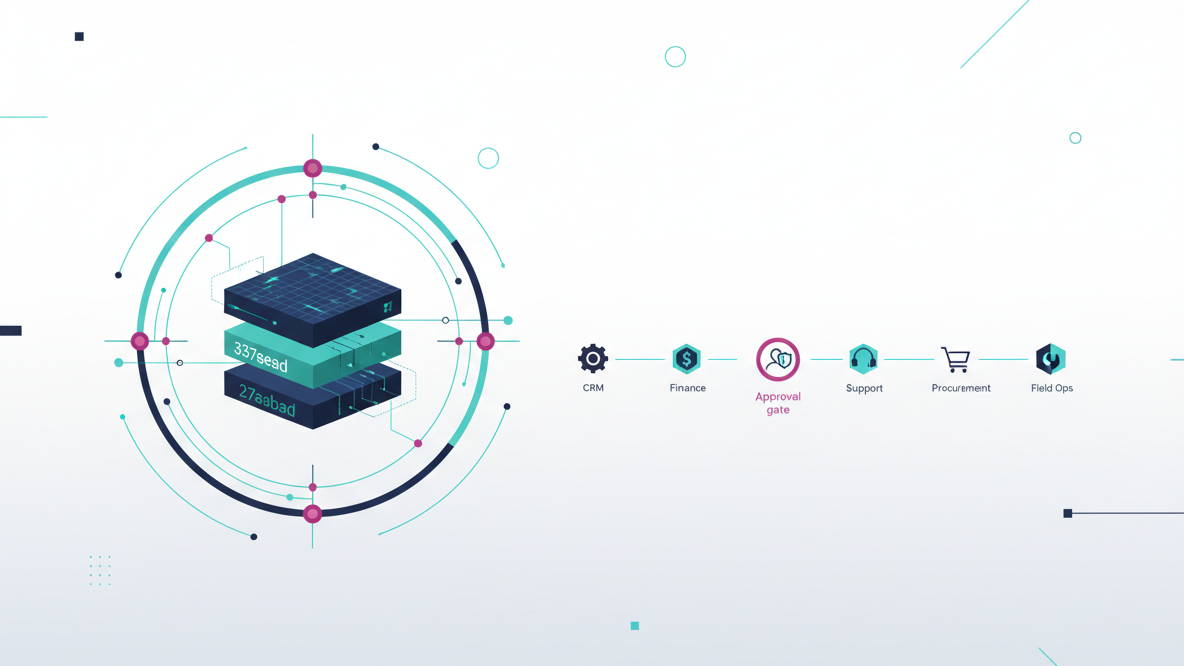
APIs play a crucial role by exposing contextual data across systems—enabling interoperability between departments that traditionally rely on human bridges.
When integrated with role-based access control and audit trails:
- Decisions become traceable
- Context becomes reproducible
- Financial categorization (how costs and revenue are tagged and rolled up)
- Outcomes become optimizable
Over time, knowledge flows frictionlessly across teams without depending on specific individuals.
Step 4: Put expertise into the interface (without dumbing it down)
Encoding tribal knowledge doesn’t mean turning experts into robots. It means reducing cognitive load while preserving nuance.
Another powerful layer is embedding contextual prompts and guided actions directly into user interfaces:
- Recommended next steps based on historical patterns
- “Similar cases” surfaced at the moment of decision
- Guardrails that prevent common failure modes
- Smart defaults that reflect how experienced operators behave
Instead of relying on memory, systems surface recommendations based on what the organization has learned.
This is how experience is systematized without diluting it.
Step 5: Continuous improvement with machine learning
Once workflows are instrumented and decisions are traceable, machine learning becomes a force multiplier.
Models can be introduced to:
- Detect anomalies (cases that deviate from normal patterns)
- Predict risk (which approvals are likely to be rejected, which tickets will escalate)
- Suggest optimizations (which steps create bottlenecks, which rules cause rework)
- Refine decision pathways (what the best operators do differently)
The key is not “AI for AI’s sake.” The real advantage is that what was once informal becomes continuously improvable.
Tribal knowledge is no longer locked in conversations—it becomes a living layer within the enterprise stack.
What changes when you can compute tribal knowledge
When systems are designed to learn from the people who use them, scalability meets context.
You move:
- From documentation to computation
- From dependency to design
- From heroics to repeatability
And the business gains:
- Faster onboarding (because the system teaches the process)
- Higher consistency (because decisions follow governed logic)
- Better resilience (because knowledge isn’t tied to individuals)
- Clearer accountability (because decision points are auditable)
- Stronger performance (because workflows can be optimized with evidence)
The question every leadership team should ask
If your organization still relies on “go ask that one person,” you’re sitting on untapped operational intelligence.
The question is: are you capturing it—or losing it?
Tribal knowledge becomes scalable when encoded into adaptive enterprise workflows.
If you want to explore what this looks like in your environment—where to instrument, what to encode, and how to build systems that learn—let’s discuss how to turn tribal knowledge into a structured, scalable advantage.